












April 22, 2026
DC vs AC Coupling: Choosing the Right Solar Battery System
Share my #SolaXStory


Are you planning to install solar panels and battery storage for your home? Then you've likely encountered the terms "AC coupling" and "DC coupling." These technical concepts determine how your solar panels, batteries, and home grid connect together, directly impacting system efficiency, costs, and future expandability.
This comprehensive guide will break down the core differences between dc vs ac coupling, compare ac coupled vs dc coupled systems, and provide clear decision-making guidance to help you choose the most suitable solution.
The Foundation: What is AC and DC Current?
Simply put, think of AC and DC as two different "electrical languages."
Direct Current (DC): The current flows in one constant direction. Your solar panels generate DC power, and batteries store and release DC power.
Alternating Current (AC): The current periodically changes direction rapidly. Your home's electrical grid and most household appliances (like refrigerators, TVs) operate on AC power.
Because these two different "languages" exist, we need a device called an inverter to act as a translator between them. AC coupling and DC coupling are two different strategies about when and where this "translation" process occurs.
What is AC Coupling?
In an AC-coupled system, solar power goes through a "convert first, store later" process.
Power Flow Path: Solar panels (DC) → Solar Inverter → Home Grid (AC) → Battery Inverter → Battery (DC)
Core Components: 1 Solar Inverter + 1 AC-coupled battery system (with built-in battery inverter/charger)
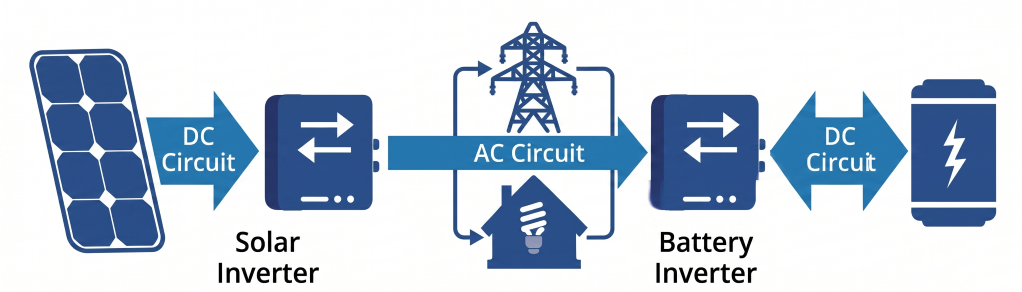
This configuration works like two independent systems connected through the AC electrical circuit.
Key Features of AC-Coupled Battery Systems
AC coupled battery storage systems are popular for grid-connected homes, especially when homeowners want to add storage to existing solar installations. Key characteristics include:
Independent Solar and Battery Operation
The solar system and ac coupled battery backup operate independently because each uses its own inverter. This design allows simultaneous or separate operation.
Easy System Expansion
Many homeowners install solar panels first and add ac coupled battery storage later. AC coupling makes this process seamless without redesigning the original solar array.
Excellent Compatibility
You can combine different brands and models of solar inverters with various ac coupled solar battery products.
What is DC Coupling?
In a dc coupled system, solar power follows a "store first, convert later" approach.
Power Flow Path: Solar Panels (DC) → Charge Controller → Battery (DC) → Hybrid Inverter → Home Grid (AC)
Core Components: 1 Hybrid Inverter that simultaneously manages solar input and battery charging/discharging
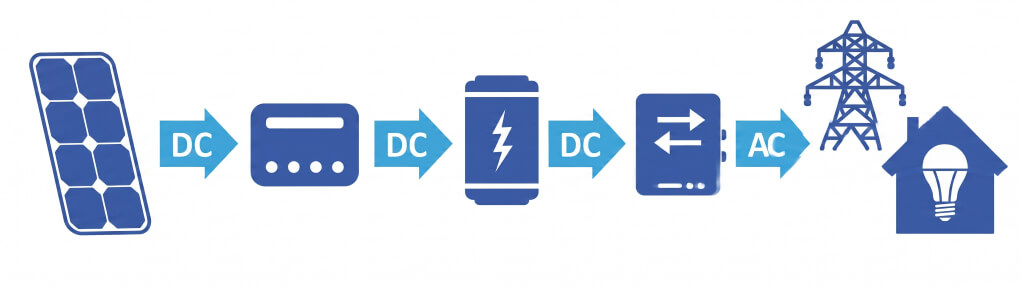
This configuration is more integrated, with all power managed in one central device.
Key Features of DC-Coupled Battery Systems
DC coupled battery systems are typically found in new solar installations where battery storage is planned from the beginning. Key characteristics include:
Single Hybrid Inverter Architecture
A hybrid inverter manages both solar generation and battery storage, simplifying electrical design.
Direct Energy Storage
Solar energy flows directly from panels to the dc coupled solar battery without intermediate AC conversion.
Optimized Solar Charging
The system controller manages both solar production and battery charging for improved energy optimization.
Core Differences at a Glance: AC Coupling vs DC Coupling
To help you better understand the difference between ac coupled and dc coupled solar battery systems, we've prepared this comprehensive table:
Feature | AC Coupling | DC Coupling |
Core Equipment | Solar Inverter + Battery Inverter | Hybrid Inverte |
Number of Conversions | Multiple (DC→AC→DC→AC) | Single (DC→AC) |
Battery Round-trip Efficiency | Lower | Higher |
Best Use Case | Adding batteries to existing solar | New solar+storage installations |
Retrofit Complexity | Low, plug-and-play | High, requires core equipment replacement |
System Flexibility | High, independent solar and battery | Lower, limited by hybrid inverter |
Daytime AC Load Efficiency | Very high (up to 97%) | Good (but one extra conversion) |
Battery Charging Efficiency | Lower | Very high |
The Showdown: AC Coupling vs. DC Coupling Pros & Cons
Here, we break down the specific advantages and disadvantages of each system to help you understand which is the right fit for your home.
AC Coupling: The Flexible Retrofit King
Why You'll Love AC Coupling
Perfect for Upgrades: Easily add a battery to any existing solar system. It's fast, simple, and cost-effective.
Ultimate Flexibility: Mix and match different brands of solar and battery equipment. Upgrading one part doesn't mean you have to replace the whole system.
Grid Charging Ready: Take advantage of cheap, off-peak electricity by charging your battery from the grid.
The Downsides of AC Coupling
Lower Efficiency: More power conversions mean less of your stored solar energy makes it to your appliances (lower round-trip efficiency).
Higher Cost for New Systems: For a new installation, buying two separate inverters is often more expensive than one integrated unit.
DC Coupling: The Integrated Efficiency Champion
Why You'll Love DC Coupling
Maximum Efficiency: Power takes a direct DC-to-DC path from panels to battery. This means more of your solar energy is stored and used, saving you more money.
Ideal for New Systems: A single all-in-one Hybrid Inverter simplifies installation and often results in a lower initial hardware cost.
Superior Backup Power: "Black Start" capability is standard. In an outage, your solar panels can directly recharge your battery, keeping your lights on indefinitely.
The Downsides of DC Coupling
Difficult to Retrofit: Adding a DC-coupled battery to an existing solar system is complex and expensive, usually requiring a full inverter replacement.
Less Flexible: Your entire system is tied to the specifications of one Hybrid Inverter, which can limit future expansion options.
Should I Choose AC Coupling or DC Coupling?
Forget the complex technical jargon. To find your answer, simply identify your situation below. This is the most critical part of understanding the ac coupled vs dc coupled choice.
Scenario 1: You ALREADY have a solar PV system and want to add a battery.
Your Answer: In 99% of cases, choose AC Coupling.
The "Why": This is by far the most economical and straightforward path. You simply add an ac coupled battery system to your existing setup. The installation is quick, minimally invasive, and doesn't require replacing your current solar inverter. Look for one of the best ac coupled battery products on the market, and you're good to go.
Scenario 2: You are installing a BRAND NEW system with both solar and battery from scratch.
Your Answer: Strongly consider DC Coupling as your primary option.
The "Why": You're in a perfect position to build a highly efficient, integrated system. With DC coupling, you'll benefit from higher overall efficiency (more savings), potentially lower initial hardware costs (one inverter instead of two), and superior backup power performance. It’s the modern, all-in-one solution.
Scenario 3: You are building an OFF-GRID home or require mission-critical backup power.
Your Answer: DC Coupling is almost always the necessary choice.
The "Why": For an off-grid ac coupled vs dc coupled BESS, reliability is everything. DC coupling's superior efficiency and robust "Black Start" capability—the ability to restart the system using only solar power after a complete shutdown—are essential for maintaining a stable, self-sufficient power supply.
Conclusion
In the end, the choice between AC vs DC coupling isn't about which is universally "better," but which is perfect for your situation.
Let's simplify it to a final takeaway:
AC Coupling is the undisputed champion of retrofits and flexibility. If you're upgrading an existing solar system, this is your path.
DC Coupling is the efficiency and integration king for new installations. If you're starting fresh, this is the modern, powerful choice.
By understanding your unique requirements and the distinct strengths of each technology, you are now fully equipped to make a smart, confident investment in your home's energy future.
FAQ
Table of Contents
Latest News
Explore expert insights, practical guides, and the latest news on SolaX Power.


To the Latest Newsletter
Stay Ahead with the Latest SolaX Updates!
Subscribe
I have read and agree to Privacy Policy and User Terms