











May 13, 2026
What Size Inverter Do I Need? Free Inverter Load Calculator
Share my #SolaXStory


Choosing the wrong inverter can be expensive. If you buy one that's too small, your appliances may start beeping, triggering overload alarms, or constantly shutting the inverter down. If you buy one that's too large, you're not only overspending upfront — you may also increase idle power consumption and put unnecessary strain on your battery system.
So it's no surprise that many people ask: how big inverter do I need?
The good news is that it's not complicated. After reading this guide, you'll be able to calculate the correct inverter size in just a few minutes — and choose the right power capacity with confidence.
The Basics: Running Watts vs. Surge (Starting) Watts
Before diving into the calculations, the absolute key to choosing the right inverter lies in understanding one critical concept: running watts vs starting watts.
To power your setup safely, the inverter you buy must be capable of handling both of the following:
Running Watts (Continuous Watts): This is the standard amount of power an appliance consumes to operate normally on an ongoing basis.
Surge / Starting Watts: Some appliances — especially those with motors like refrigerators, air conditioners, pumps, or power tools — require a sudden burst of power when they start. This surge can be higher than their running watts and usually lasts a few seconds.
When you look at an inverter's specification sheet, these two appliance requirements correspond directly to inverter rated output and peak power.
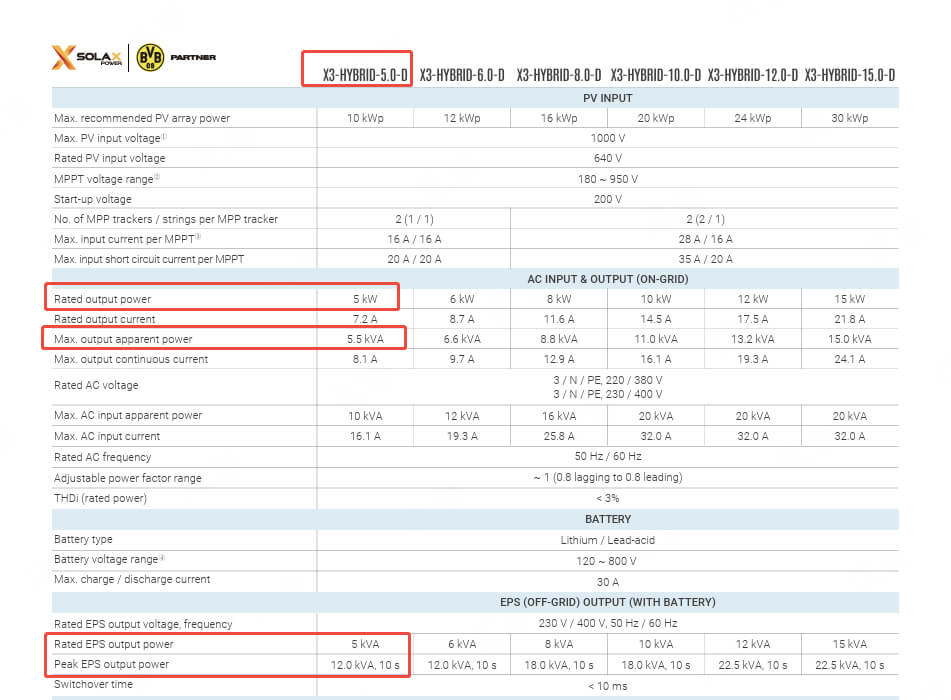
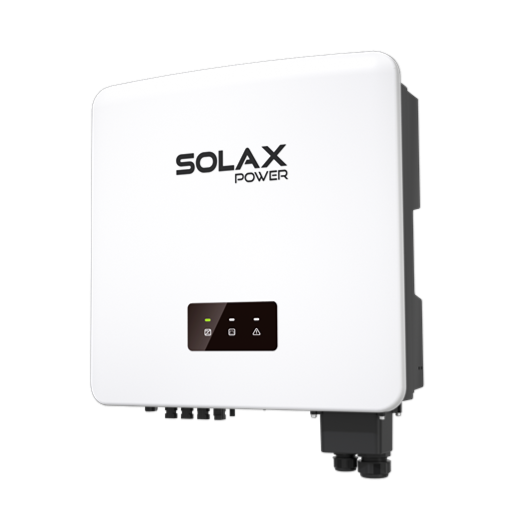
Take SolaX X3-Hybrid-5.0-D model as an example:
Continuous Watts: Your total running power for all appliances must stay below 5 kW.
Surge Watts: For devices with motors (like fridges or pumps), their combined starting power must not exceed 12.0 kVA (for a maximum of 10 seconds).
Staying within these two limits ensures the inverter can handle both your daily power needs and the high-energy "bursts" required to start heavy machinery.
How to Calculate Load for Inverter? (3 Simple Steps)
Don't worry about complex math—learning how to calculate inverter size is actually very straightforward. Just follow this simple 3-step method to accurately calculate load for inverter and find your perfect match.
Step 1: List All Appliances You Want to Run at the Same Time
Start by writing down every device you plan to power simultaneously. Your inverter must handle the total load of everything running at once — not individually.
Step 2: Add Running Watts + Check Highest Surge
First, add up the continuous running watts of all the devices on your list to get your total base load. Next, look at your list and identify the single appliance with the highest starting (surge) watts.
You generally only need to account for the largest surge wattage, as it's highly unlikely that all your heavy appliances will kick on at the exact same millisecond.
Step 3: Apply the Golden 20% Rule
You should never run your inverter at 100% maximum capacity for long periods, as this causes excessive heat and shortens its lifespan.
Always take your total calculated running watts and add a 20% safety margin. This ensures your inverter runs efficiently, stays cool, and has a little extra room to breathe.
Inverter Load Calculator
If you want to skip the math, you can simply select your appliances and plug your numbers into interactive inverter load calculator embedded below.
However, if you are building a custom solar or RV setup, understanding how an inverter size calculator actually works behind the scenes is incredibly helpful. Every reliable sizing tool is based on one fundamental inverter sizing formula.
Minimum Inverter Size = Total Running Watts × 1.2
For example, if your total running load is 1000W, multiplying by 1.2 gives you a minimum recommended inverter size of 1200W.
What Size Inverter Do I Need for Different Situations?
When determining how big inverter do I need, the "one size fits all" approach doesn't work. The right capacity depends heavily on whether you are powering a mobile lifestyle or a stationary residence. The parameters for some basic household appliances are as follows.
Appliance | Running Watts | Surge Watts |
Refrigerator | 300W - 800W | 1000W - 1500W |
Microwave | 600W - 1500W | 1200W - 3000W |
TV (50" LED) | 50W - 200W | 50W - 200W |
What Size Inverter Do I Need for My Home?
For a typical home backup system, you need to account for essential circuits. Most homeowners find that a 3000W to 5000W inverter is the sweet spot. This allows you to run lights, a refrigerator, and perhaps a small pump or microwave simultaneously.
If you plan to power heavy-duty 240V appliances like a well pump or central AC, you will likely need a 6000W+ split-phase inverter.
What Size Inverter Do I Need for My RV or Camper?
Life on the road requires efficiency. For a standard RV or camper setup, a 2000W to 3000W inverter is the industry standard. This capacity is sufficient to run a coffee maker, laptop chargers, and even the rooftop AC (if your battery bank can handle the discharge).
If you only need to charge phones and run a small TV in your camper, a 1000W inverter may suffice.
Common Mistakes When Choosing the Right Inverter
Choosing the right inverter is not just about picking the most powerful or the cheapest option. Many buyers overlook key technical details, which can lead to poor performance, equipment damage, or unnecessary expenses. Understanding how to size an inverter properly can help you avoid the following common mistakes.
1. Ignoring Total Power Requirements
One of the biggest mistakes is underestimating the total wattage of the devices you plan to run. Many people only consider running watts and forget about surge watts, especially for appliances like refrigerators, air conditioners, and power tools.
When learning how to size an inverter, always calculate both continuous wattage and peak surge requirements to ensure smooth operation.
2. Choosing the Wrong Waveform
Not all inverters produce the same type of output. Modified sine wave inverters are cheaper but may not be suitable for sensitive electronics, medical equipment, or variable-speed motors.
If you're unsure how to size an inverter for sensitive devices, consider selecting a pure sine wave inverter for better compatibility and performance.
3. Not Considering Battery Capacity
Even if you correctly size your inverter, an undersized battery bank will limit runtime. The inverter and battery system must work together.
A complete understanding of how to size an inverter also includes calculating battery capacity based on load and desired backup time.
4. Ignoring Future Expansion
Many users size their inverter only for current needs. However, future upgrades—such as adding more appliances or expanding a solar system—can quickly exceed capacity.
When deciding how big inverter do I need, it's wise to allow some headroom (typically 20–30%) for future expansion.
5. Focusing Only on Price
Low-cost inverters may lack essential protection features such as overload protection, thermal shutdown, or short-circuit protection. Choosing purely based on price can lead to higher long-term costs.
SolaX Best Solar Inverter Sizes by Use Case
As one of the world's leading solar and energy storage solution providers, SolaX brings over 10 years of industry experience, supported by 1,000+ R&D professionals and a comprehensive portfolio of inverter technologies. From residential hybrid systems to fully off-grid applications, SolaX offers different inverter types and sizes designed to meet diverse energy demands with high efficiency, reliability, and smart energy management.
To help you choose the right solution, here are recommended SolaX inverter options based on different use cases:
For Home Backup & Residential Solar Systems
By integrating solar PV and battery storage into one seamless system, SolaX delivers higher self-consumption, intelligent energy management, and uninterrupted power during grid outages.
Top Product Recommendation: SolaX X1-Hybrid G4
Available Sizes: 3.0kW / 3.7kW / 5.0kW / 6.0kW / 7.5kW
The X1-Hybrid G4 is one of the most popula 0r choices for residential solar and home backup applications. Designed for single-phase homes, it combines performance, flexibility, and smart functionality in one compact unit.
Up to 200% PV oversizing, maximizing solar energy harvest
Up to 97% battery charge and discharge efficiency
VPP-ready (Virtual Power Plant) capability
Supports both on-grid and off-grid solar energy storage systems
Intelligent monitoring via SolaXCloud
This makes it ideal for powering essential loads such as refrigerators, lighting, internet routers, and even larger appliances during outages.
For Off-Grid Cabins & Small Residences
Designed as essential infrastructure for remote living, SolaX offers a modular and resilient solution that stabilizes power supply in weak-grid and off-grid environments.
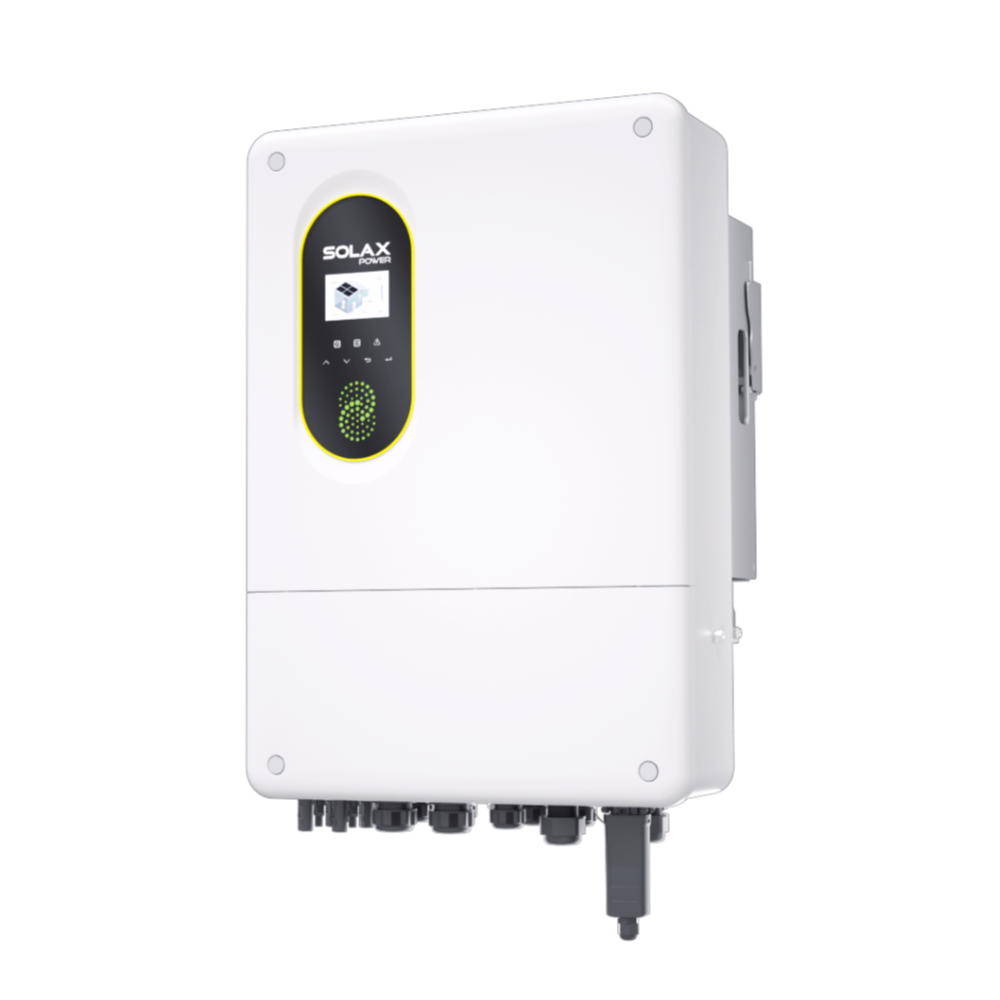
Top Product Recommendation: SolaX OG Series
Available Models: 5.0kW / 6.0kW
The OG Series is a purpose-built off-grid platform engineered for household resilience and scalability. It bridges the gap between unreliable grid access and total energy independence, offering high performance in a compact design that is 30% smaller and 20% lighter than comparable systems.
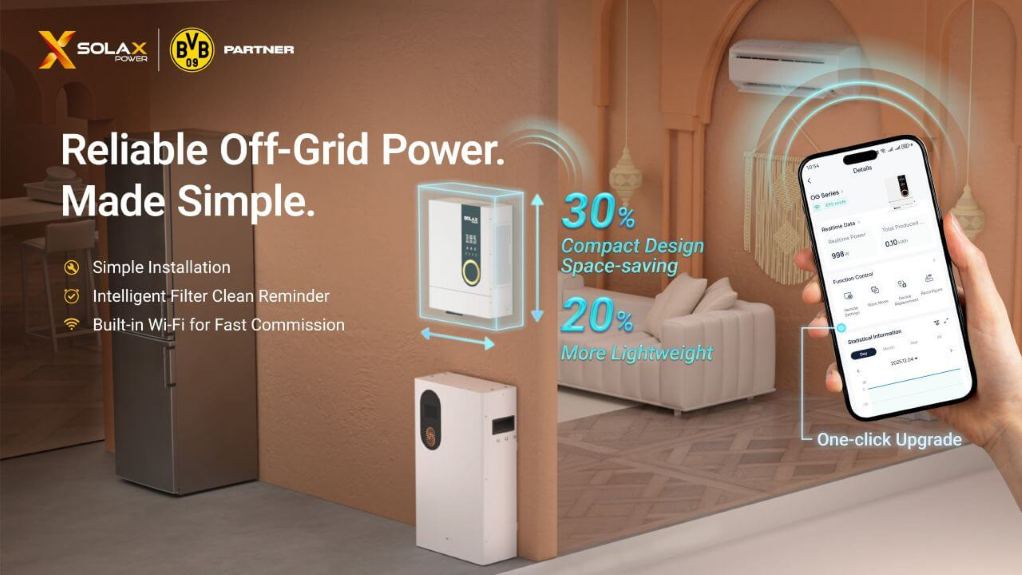
Max 28A PV input current, ensuring easy compatibility
Superior 140A discharge current, exceeding the industry average by 20%
Ultra-fast < 4ms seamless switching, ensuring lights and electronics continue
Up to 200% AC output overloading for 5 seconds to handle high-surge appliances
Dedicated Generator (GEN) port for smart load management
This makes it the perfect choice for remote cabins, island homes, and rural residences where reliable, stable electricity is a necessity for daily life and business operations.
For All-in-One Energy Solutions
SolaX delivers a complete home energy hub that integrates solar generation, battery storage, and intelligent energy management into one seamless system — designed to power modern households efficiently and reliably.
Top Product Recommendation: SolaX X3-IES-P
Available Sizes: 4kW / 5kW / 6kW / 8kW / 10kW / 12kW / 15kW
The X3-IES-P is a versatile three-phase hybrid storage system built specifically for residential applications. Acting as the “energy brain” of your home, it intelligently coordinates solar PV, grid power, and optional generator input to maximize self-consumption, reduce electricity bills, and ensure reliable backup power when needed.
Up to 200% PV oversizing, maximum energy harvest
Up to 20A per MPPT, fully compatible with residential solar modules
98% peak efficiency, lower long-term costs
Comprehensive safety protections, including overvoltage and anti-islanding protection
Flexible compatibility (PV / grid / generator) for a truly integrated home energy ecosystem
This makes the X3-IES-P an ideal solution for villas, large family homes, and three-phase residential properties seeking a reliable, high-performance, all-in-one solar and ststem.
FAQ
Table of Contents
Latest News
Explore expert insights, practical guides, and the latest news on SolaX Power.


To the Latest Newsletter
Stay Ahead with the Latest SolaX Updates!
Subscribe
I have read and agree to Privacy Policy and User Terms