












January 04, 2026
Which Flexible MW Configuration (2.5MW, 5MW, 7.5MW) Is Best for Utility Services?
Share my #SolaXStory


Successful deployment of large-scale battery energy storage systems (BESS) hinges on making calculated decisions regarding the Power-to-Energy (P/E) ratio, which determines how long a system can sustain its maximum output. The global momentum for large-scale energy storage has reached a critical tipping point.
According to Wood Mackenzie, 2025 marked the first year that annual global energy storage installations surpassed 100 GW, growing 43% year-over-year to reach 106 GW of new capacity. This rapid expansion underscores the urgent need for modular, flexible solutions like the ORI product line that can scale quickly to meet massive grid demand(Wood Mackenzie: Global energy storage market surpasses 100 GW annual installation milestone in 2025).
For Utility-Scale Plant Solutions, this sizing choice directly impacts profitability, dictating whether the asset primarily serves long-duration energy arbitrage or high-power frequency regulation. The ORI product line, categorized as a Utility All-In-One ESS, addresses this challenge by offering flexible capacity configurations centered around three primary Power Conversion System (PCS) ratings: 2.5 MW, 5.0 MW, and 7.5 MW.
Determining the ideal MW configuration is crucial for utility developers. It requires a detailed technical assessment that maps the specific revenue streams and grid code requirements to the appropriate P/E ratio. The SolaX ORI Liquid Cooling ESS System is engineered to simplify this process, providing highly integrated, containerized blocks that ensure reliable performance and accelerated commissioning, regardless of the chosen power rating.
1. Deconstructing the ORI Modular Architecture
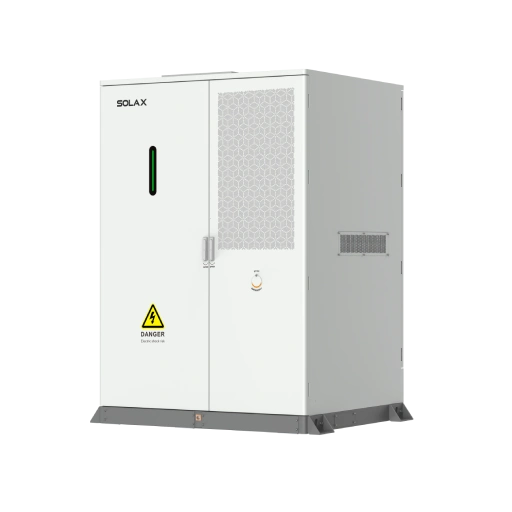
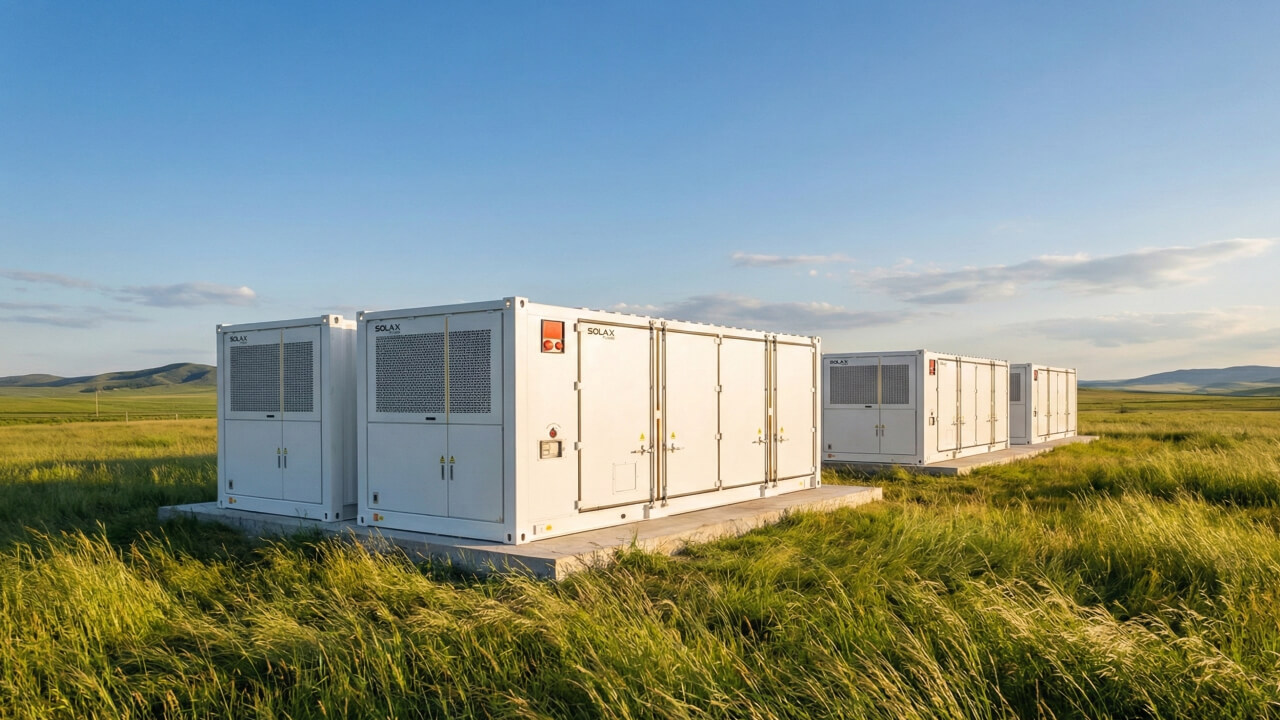
The ORI system is purpose-built for the rigorous demands of Utility-Scale Plant Solutions, designed as an integrated solution that combines high-quality LFP battery cells and advanced liquid cooling within a standardized container. This modularity simplifies scaling and ensures rapid deployment across large sites.
1.1 The Base Energy Unit: ORI-B5015L-2H
All configurations rely on the foundational energy module, the ORI-B5015L-2H. This unit defines the energy duration component (E) of the P/E ratio.
Rated Energy Capacity: 5015 kWh. This large capacity allows for multi-hour discharge capabilities, crucial for utility arbitrage and capacity markets.
Cooling Method: The unit utilizes Liquid cooling, which is essential for maintaining cell health and performance across varied utility duty cycles.
DC Voltage: The module operates at a high DC rated voltage of 1331.2 V, contributing to overall system power density.
Physical Footprint: The unit is housed in a container with dimensions of 6058 x 2896 x 2438 mm.
1.2 The Flexible Power Units (P): 2.5 MW, 5.0 MW, and 7.5 MW
The utility market is moving beyond simple grid stabilization. In 2024, energy shifting accounted for 67% of all new storage capacity additions, signaling a major industry pivot toward longer-duration energy arbitrage(IRENA: Battery Energy Storage Systems: Key to Renewable Power Supply-Demand Gaps). SolaX's flexible ORI configurations (2.5MW to 7.5MW) are specifically engineered to support this trend, allowing operators to optimize energy shifting across diverse grid requirements while maximizing project profitability.
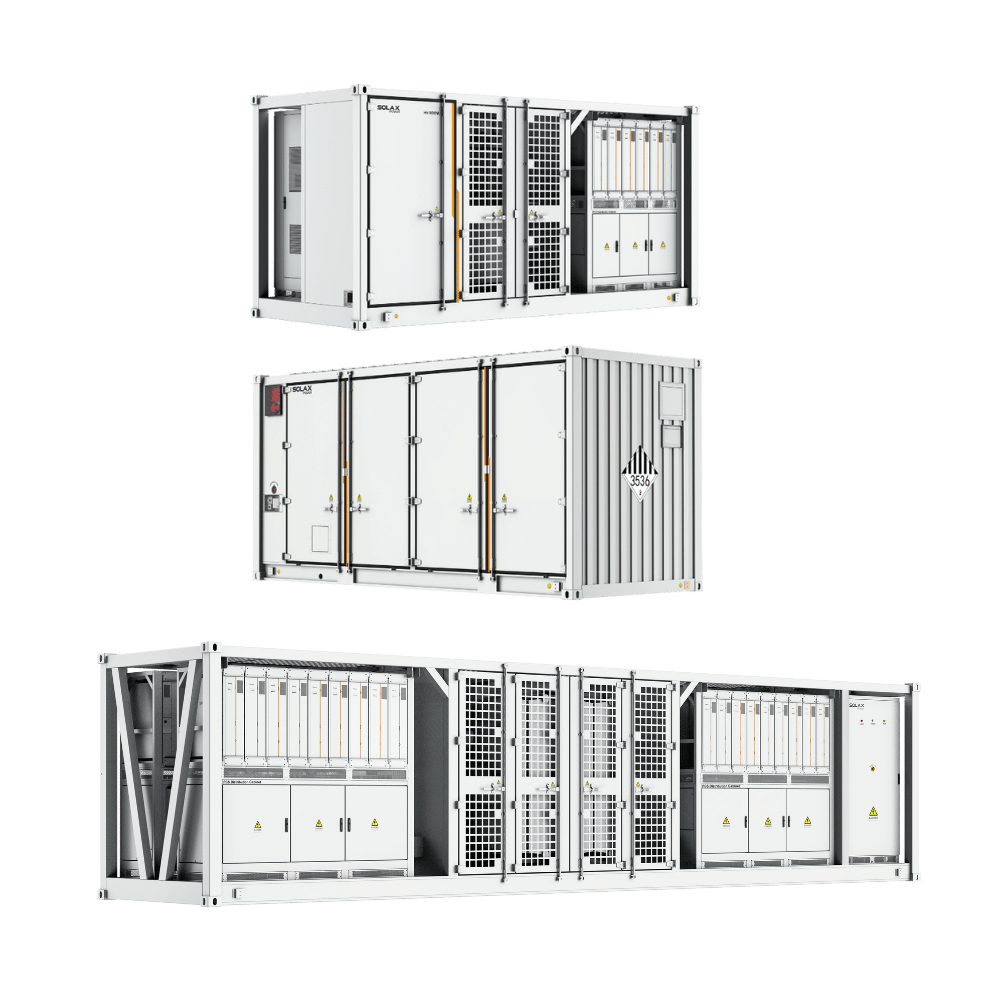
The flexibility of the ORI system is provided by three distinct containerized PCS units, which dictate the maximum power output (P) available to the grid. Each unit is designed for high-voltage DC input (Max. DC voltage of 1500 V) and high-voltage AC output (Rated AC voltage typically 6–35kV), essential specifications for direct integration into utility distribution and transmission infrastructure.
ORI Power Unit (P) | Rated AC Power | Rated AC Voltage | Container Size (W x H x D) | Max. Operating Altitude |
ORI-P2500 | 2500 kVA (2.5 MW) | 6-35kV | 6058 x 2896 x 2438 mm | ≤2000 m (optional: 4000m) |
ORI-P5000 | 5000 kVA (5.0 MW) | 10-35kV | 12192 × 2896 × 2438 mm | ≤2000 m (optional: 4000m) |
ORI-P7500 | 7500 kVA (7.5 MW) | 10-35kV | 12192 × 2896 × 2438 mm | ≤2000 m (optional: 4000m) |
1.3 Establishing the P/E Ratio and Duration
The effective duration (T) of a configuration is determined by dividing the battery energy capacity (E) by the PCS power rating (P). For the ORI, using the 5015 kWh battery unit as the constant, the three primary durations are established:
Configuration | Power (P) | Energy (E) | P/E Ratio | Duration (Approximate) | Primary Utility Focus |
Low-Power/Long-Duration | 2.5 MW | 5.015 MWh | 0.5:1 | 2 Hours | Arbitrage, Capacity |
Balanced/Medium-Duration | 5.0 MW | 5.015 MWh | 1:1 | 1 Hours | Reserves, Ramping |
High-Power/Short-Duration | 7.5 MW | 5.015 MWh | 1.5:1 | 40 Minutes | Frequency Regulation, Congestion Relief |
2. Economic Mapping of MW Configurations to Utility Services
The selection of the optimal MW configuration is an economic decision based entirely on the targeted revenue streams and the regulatory requirements of the Independent System Operator (ISO) or utility control area. The flexibility of the ORI system’s capacity configuration (2.5/5/7.5MW) allows developers to precisely match capital expenditure to maximum revenue potential.
2.1 The 2.5 MW Configuration: Maximizing MWh Value
This configuration maximizes the discharge duration per module, resulting in the highest energy throughput for a given capital spend on power electronics.
Target Services:
Energy Arbitrage (E-focused): This 2-hour-plus configuration is ideal for markets that exhibit clear, sustained price separation, such as daily peaks requiring several hours of discharge to capture maximum value. By maximizing MWh deliverability, it optimizes the utilization of stored energy.
Resource Adequacy/Capacity: Many capacity market requirements mandate sustained output over 2 to 4 hours. The 2.5 MW configuration is highly efficient at meeting these requirements with minimal cycling stress.
Operational Considerations: Choosing 2.5 MW results in a slower cycling rate, which typically reduces calendar aging stress on the battery cells and can extend the overall asset life, a key factor for long-term Utility-Scale Plant Solutions.
2.2 The 5.0 MW Configuration: The Versatile Workhorse
The 1:1 P/E ratio is the standard for versatility in utility BESS, balancing the high cost of instantaneous power (MW) with the necessary duration (MWh) for contingency events.
Target Services:
Contingency Reserves: This is the ideal sizing for providing 1-hour operating reserves, which is critical for system stability following a large generator or transmission fault. The system can deploy its full power quickly and sustain it long enough for conventional generation to stabilize.
Renewable Ramping Control: In grids with high solar penetration, the 5.0 MW unit can provide rapid ramping support for up to an hour to counteract sudden cloud cover or sunset ramps, preventing instability.
Economic Considerations: The 5.0 MW configuration offers the best Cost Reduction & Efficiency balance, minimizing the risk of over-sizing while maintaining high flexibility to participate in multiple, stacked markets simultaneously.
2.3 The 7.5 MW Configuration: Prioritizing MW Density
The highest power density configuration is reserved for markets that place a premium on rapid, high-MW delivery, even if the duration is limited to minutes rather than hours.
Target Services:
Fast Frequency Regulation (FFR): FFR requires the battery to rapidly absorb or inject high power to keep grid frequency stable. The 7.5 MW unit provides the necessary instantaneous power output to maximize FFR revenue.
Transmission Congestion Relief: When localized transmission lines are at capacity, a sudden, high-MW injection from the 7.5 MW unit can provide temporary relief, a service that is highly valued but short-lived.
Technical Considerations: This configuration places the highest stress on the PCS and thermal management. The high-efficiency 99.04% PCS and robust Liquid cooling are non-negotiable for sustained, high-power cycling at this level.
3. Deployment and Operational Excellence via ORI Integration
Regardless of the chosen MW configuration, the success of a utility project depends on its ability to be deployed quickly and operated reliably under harsh conditions. The integrated design of the SolaX ORI system provides critical advantages in both areas.
3.1 Accelerated Deployment and Time-to-Revenue
Minimizing on-site installation and commissioning time is paramount for utility developers. The ORI's design is focused on accelerating the project timeline, which is a core advantage of its Utility All-In-One ESS classification.
Factory Pre-Assembly: The modular design and Factory pre-assembly significantly shorten the overall construction schedule. This approach reduces potential errors associated with field integration of separate PCS and battery components.
Pre-Commissioning: Factory pre-commissioning effectively "halves debugging time" by ensuring all subsystems—from internal protection to cooling—are tested before shipping. This preparation enables rapid deployment and is instrumental in achieving grid connection in as little as 15 days, SolaX also notes the potential for 2-hour single-unit installation.
3.2 Advanced Thermal Management and Efficiency
Thermal management is the single most critical factor for preserving battery health and maximizing efficiency, especially for high-MW configurations.
Thermal Uniformity: The Liquid Cooling ESS System is designed to ensure ≤3°C temperature uniformity across the battery packs. This consistency prevents the localized heating and uneven aging that plague less sophisticated cooling solutions, protecting the asset's overall capacity and reducing derating.
Energy Savings: The cooling system's optimized low-flow resistance pipeline design ensures uniform cooling with minimal parasitic energy consumption. Furthermore, the system's High-efficiency 99.04% PCS maximizes the energy throughput, ensuring that the maximum percentage of stored DC energy is converted to AC power for the grid. This Innovative Energy Savings approach lowers operational costs while maximizing energy efficiency.
3.3 Robust Safety and System Reliability
Utility-scale assets require multi-layered protection to ensure grid stability and physical safety. The ORI integrates several layers of Collaborative Protection.
Electrical Safety: The system features Multi-layered electrical safety, including 4-layer fuse protection and dual-layer insulation monitoring. This robust protection is essential for safely managing high-voltage (1500 V DC) operation.
Fault Management: An integrated Coordinated shutdown mechanism is crucial for managing faults safely, reducing the spread of failure and minimizing component damage. Furthermore, the modular design enhances uptime and scalability.
Monitoring and Control: Comprehensive Monitoring is achieved via real-time, full-spectrum data collection, supporting AI-driven anomaly detection and automated fault isolation. This capability minimizes system impact and ensures high reliability, supported by Smart Energy Management tools like SolaXCloud and VPP functionality.
4. Technical Deep Dive and Selection Checklist
When validating the configuration choice, utility developers must look beyond basic MW/MWh numbers and verify that the system can perform reliably under real-world conditions.
4.1 System Footprint and Environment
The physical size and environmental resilience of the chosen containerized unit (ORI-P2500, ORI-P5000, or ORI-P7500) must fit the site constraints.
Size Difference: The 2.5 MW PCS unit uses a single standard 20ft container footprint (6058 mm length), whereas the 5.0 MW and 7.5 MW units require a 40ft container footprint (12192 mm length),,. This affects site layout and logistics.
Altitude and Harsh Conditions: The units are rated for altitudes up to 2000 m (with optional support for 4000m). The system is built with IP55 outdoor cabinet and IP66 components to handle harsh outdoor conditions.
4.2 Maintenance and Uptime
High reliability demands minimal Mean Time To Repair (MTTR). The ORI system's design philosophy incorporates maintenance efficiency as a key advantage.
Modular Maintenance: The modular design enhances uptime and scalability. SolaX advertises Rapid maintenance with 1-hour part replacement, which minimizes downtime and maximizes the availability of the utility asset. This is vital for maintaining service agreements regardless of the configuration size.
4.3 Integrated Smart Energy Management (SEM)
While the business case for storage has matured, the economics have never been more favorable. BloombergNEF reports that stationary storage battery pack prices plummeted 45% in 2025 to just $70/kWh, the steepest decline in the industry(BloombergNEF: Lithium-Ion Battery Pack Prices Fall to $108 Per Kilowatt-Hour). By utilizing the ORI Liquid Cooling ESS, developers can leverage these record-low component costs while benefiting from SolaX's high-density, integrated design to further reduce balance-of-system (BOS) expenses.
The chosen MW configuration is only as useful as the controls managing it. The ORI solution integrates Smart Energy Management via SolaXCloud and supports VPP integration.
SEM Feature | Application to MW Configurations | Benefit for Utility-Scale Plant Solutions |
SolaXCloud | Real-time monitoring and data management | Supports high-level control and warranty tracking |
VPP Integration | Coordinated dispatch across multiple units | Optimizes the fleet for market participation and grid services |
Intelligent Clusters | Maximizes output and efficiency | Ensures consistent performance regardless of configuration size |
5. Conclusion
The selection between the 2.5 MW, 5.0 MW, and 7.5 MW configurations of the SolaX ORI Liquid Cooling ESS System is fundamentally dictated by the utility service market targeted. The Flexible capacity configuration (2.5/5/7.5MW) allows utility developers to precisely tailor the P/E ratio, optimizing the system for long-duration arbitrage, balanced contingency reserves, or high-power frequency regulation.
Crucially, the ORI ensures operational consistency and deployment speed across all sizes. By leveraging Liquid cooling to maintain ≤3°C temperature uniformity, integrating a high-efficiency 99.04% PCS, and utilizing Factory pre-commissioning for grid connection in as little as 15 days, the SolaX solution provides a robust and scalable platform for Utility-Scale Plant Solutions, regardless of the required power rating. The optimal choice is the configuration that maximizes project profitability while maintaining the stringent safety and reliability standards required by the grid.
FAQ
Table of Contents
Latest News
Explore expert insights, practical guides, and the latest news on SolaX Power.


To the Latest Newsletter
Stay Ahead with the Latest SolaX Updates!
Subscribe
I have read and agree to Privacy Policy and User Terms