













January 07, 2026
MPPT vs. PWM Solar Charge Controller: Which One Is Right for Your System?
Share my #SolaXStory


Building an off-grid solar system for your van, boat, or cabin is an exciting project, but the technical jargon can be overwhelming. One of the most common debates among solar enthusiasts is MPPT vs. PWM.
In this comprehensive guide, we'll compare MPPT and PWM technologies, explore their efficiency differences, and help you decide which controller is the best fit for your specific needs.
What is a Solar Charge Controller?
Before diving into the MPPT vs. PWM debate, let's understand what a solar charge controller does.
A solar charge controller sits between your solar panels and battery bank. Its primary job is to regulate the voltage and current coming from the panels to prevent overcharging, which can damage batteries and reduce their lifespan. Think of it as the traffic cop of your solar system—it ensures energy flows safely and efficiently.
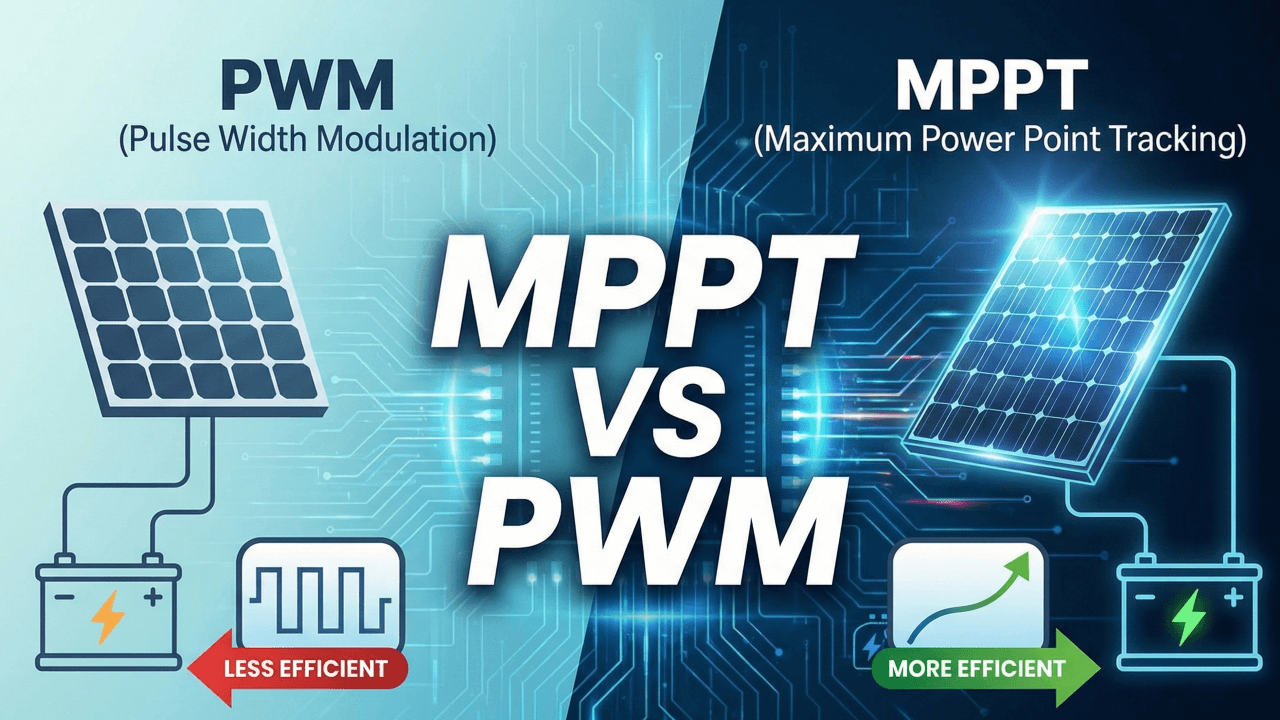
There are two main types of charge controllers on the market today: PWM (Pulse Width Modulation) and MPPT (Maximum Power Point Tracking). While both serve the same fundamental purpose, they operate very differently and offer distinct advantages.
What is a PWM Charge Controller?
PWM controllers work by creating a direct connection between the solar panel and the battery. They gradually reduce the amount of power flowing into the battery as it approaches full charge by rapidly switching the power on and off.
How PWM Technology Works
When your battery is low, the PWM controller allows full current to flow. As the battery charges, the controller sends pulses of current, adjusting the pulse width (duration) to taper the charge. This prevents overcharging while keeping the battery topped off.
Key Characteristics of PWM Controllers
Simple, proven technology with decades of reliability
Lower cost compared to MPPT alternatives
Best performance when panel voltage closely matches battery voltage
Smaller form factor suitable for compact installations
Lower power handling capacity typically under 60 amps
PWM controllers are widely used in small-scale applications like garden lights, small RV setups, and basic off-grid systems where budget is a primary concern.
What is an MPPT Charge Controller?
MPPT controllers are essentially DC-to-DC converters. They continuously monitor and adjust to find the "maximum power point"—the optimal voltage and current combination where your panels produce the most power under current conditions.
How MPPT Technology Works
Solar panel output varies with temperature, shading, and sunlight intensity. An MPPT controller uses sophisticated algorithms to track these changes in real-time, converting higher panel voltage to the lower voltage needed for battery charging while boosting current proportionally.
This voltage conversion capability is the key differentiator. When your panels produce 30V but your battery needs 12V, an MPPT controller converts that voltage difference into usable charging current rather than wasting it as heat.
Key Characteristics of MPPT Controllers
Advanced digital technology with microprocessor control
Higher efficiency especially in non-ideal conditions
Voltage flexibility allowing higher-voltage panel arrays
Better performance in cold weather and partial shading
Higher price point reflecting advanced technology
Greater power handling suitable for larger systems
Difference Between MPPT and PWM Charge Controller
When analyzing MPPT vs. PWM charge controller options, the biggest factor is how they handle energy conversion.
PWM vs. MPPT Efficiency
This is where the advantages of MPPT over PWM shine.
PWM: Because a PWM controller clips the voltage to match the battery, any voltage generated by the panel above the battery voltage is essentially lost. Its efficiency is typically around 75-80%.
MPPT: An MPPT controller takes that excess voltage and converts it into current. MPPTs can reach up to 98-99% efficiency. This can result in 15% to 30% more power harvested from your solar array.
Climate and Temperature
The mppt and pwm debate changes depending on where you live.
Cold Climates: Solar panels produce higher voltage in cold temperatures. An MPPT is far superior here because it can capture that high voltage and convert it.
Hot Climates: In very hot weather, panel voltage drops. The gap between the panel voltage and battery voltage shrinks, making the difference between MPPT and PWM charge controller efficiency less significant.
System Voltage and Array Size
If you need to compare MPPT and PWM for larger systems, MPPT almost always wins. MPPT controllers allow you to wire panels in series for much higher voltages (e.g., 48V or 96V) while charging a 12V or 24V battery bank. This reduces the wire size needed and lowers installation costs.
Quick Comparison: MPPT vs. PWM
To help you decide mppt vs pwm which is better, here is a snapshot:
Feature | PWM | MPPT |
Cost | Low (Budget-friendly) | High (Investment) |
Efficiency | 70%-80% | 95%-99% |
System Size | Best for large system (<200W) | Best for large system (>400W) |
Panel Voltage | Must match battery voltage | Can be higher than battery voltage |
Best Climate | Warm/Hot climate | Cold/Variable climates |
Making the Decision: MPPT or PWM?
The question of MPPT vs. PWM which is better depends entirely on your specific situation. Here's how to decide:
Choose a PWM Solar Charge Controller if:
You have a small system (e.g., a simple van setup or camping light).
Your solar panel voltage matches your battery voltage (e.g., a 12V panel for a 12V battery).
Budget is your primary concern.
You live in a consistently hot climate where efficiency gains from MPPT are minimal.
Choose an MPPT Solar Charge Controller if:
You want to squeeze every drop of power out of your panels (crucial for off-grid living).
You have a large solar array (over 400W).
Your panel voltage is much higher than your battery voltage (e.g., using residential house panels on an RV).
You are in a location with cloudy days or cold winters.
FAQ
Table of Contents
Latest News
Explore expert insights, practical guides, and the latest news on SolaX Power.


To the Latest Newsletter
Stay Ahead with the Latest SolaX Updates!
Subscribe
I have read and agree to Privacy Policy and User Terms