





















October 13, 2026
What Is V2X? Vehicle-to-Everything Explained for EV Charging
Share my #SolaXStory


Global electric car sales exceeded 20 million in 2025, accounting for one in four new cars sold worldwide, according to the International Energy Agency. As EV adoption grows, charging infrastructure has a role beyond supplying power to vehicles.
In the energy sector, V2X (vehicle-to-everything) describes using an EV's stored electricity to supply buildings, homes or the grid. For charging site owners, this opens up opportunities to manage peak demand and make better use of on-site solar power. This article explains how V2X works, the role of bidirectional EV chargers, and what a charging site needs to support it.
What Is V2X (Vehicle-to-Everything)?
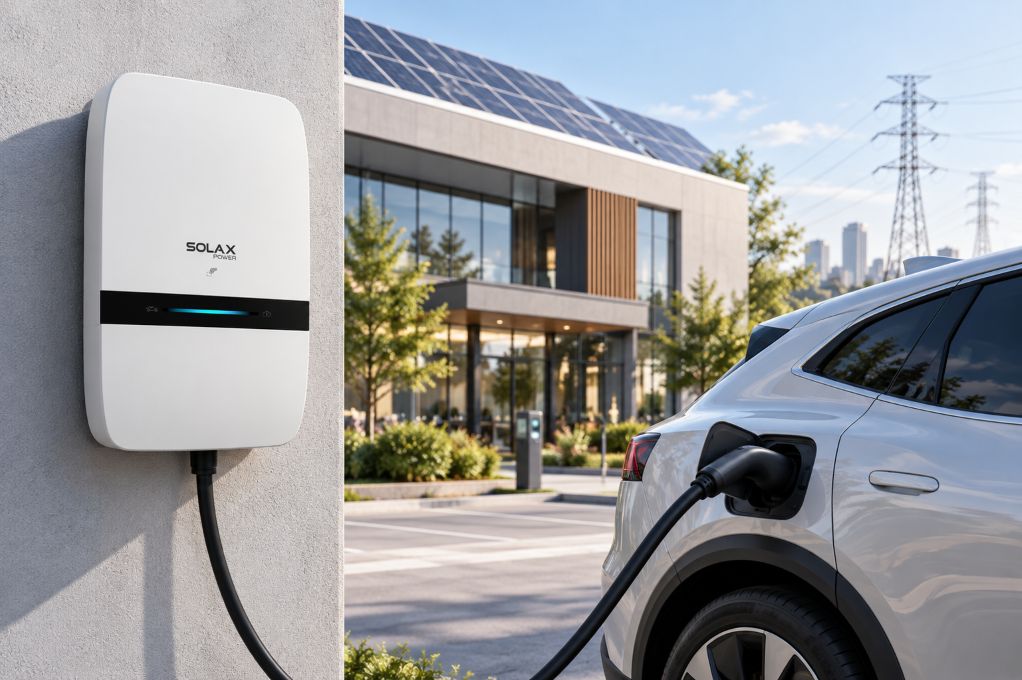
V2X stands for vehicle-to-everything. In connected transport, it refers to wireless communication between vehicles, road infrastructure and other road users. In EV charging, the same term describes supplying electricity from a vehicle's battery to external destinations.
This article focuses on the charging applications of V2X. With a compatible EV and bidirectional charging equipment, electricity can flow into the battery during charging and back out to support a home, building or the grid. These applications are known as V2H, V2B and V2G, respectively.
The charger provides the electrical connection, while control software coordinates when and how much energy is transferred within vehicle and site limits.
V2X Charging Applications: V2G, V2B and V2H
V2X charging applications differ mainly in where the electricity goes. For charging infrastructure, the three main applications are:
Application | Where the power goes | Typical use |
V2G — Vehicle-to-Grid | From the EV battery to the electricity grid | Support grid demand and participate in available energy or flexibility programs |
V2B — Vehicle-to-Building | From the EV battery to a commercial building | Help reduce peak grid electricity demand at offices, factories or fleet depots |
V2H — Vehicle-to-Home | From the EV battery to a home | Support household loads or provide backup power when the installation supports outage operation |
Each application requires compatible vehicles, bidirectional charging equipment and suitable controls; exporting electricity to the grid also requires local approval.
How Does a V2X System Work?
A V2X system connects a compatible EV battery to a building or the grid through bidirectional charging equipment. During charging, electricity flows into the battery. During discharge, stored energy flows back through the charging connection to supply the selected destination.
The charging equipment performs three key functions:
Power conversion: In a DC bidirectional charger, the converter changes AC supply power into DC for charging and converts battery DC back into AC during discharge. In an AC system, this conversion takes place inside the vehicle.
Communication: The charger exchanges operating limits and charging information with the vehicle, and connects with site controls or a management platform.
Protection: Electrical protection monitors faults and disconnects power when required. Grid export and outage operation need appropriate protection for the installation.
An energy management system (EMS) or charging platform coordinates charging and discharge based on site demand, solar generation, electricity prices and vehicle availability. It also respects battery charge limits and departure requirements, keeping enough energy available for the next journey.
Why V2X Matters for Commercial Charging Sites
For sites where compatible EVs remain parked and connected for several hours, V2X technologies can make charging infrastructure part of everyday energy management.
Use more on-site solar power: EVs can charge when solar generation is available and later supply energy to building loads, provided they remain connected and have sufficient battery capacity.
Manage peak electricity demand: Controlled discharge can help reduce a site's demand for grid electricity during busy periods. This may lower demand charges where the electricity tariff includes them.
Participate in grid services: Where local programs allow it, connected EVs can provide flexibility through coordinated charging and export. Participation may require an aggregator, approved metering and a grid connection agreement.
The financial value depends on electricity tariffs, vehicle parking schedules, available battery energy and project costs. Assessing these conditions before choosing charging equipment helps establish whether V2X offers a practical return for the site.
What to Check Before Choosing a V2X Charger
A V2X charger needs to match the intended application, connected vehicles and site infrastructure. Before selecting a bidirectional EV charger, confirm the following:
Check | What to confirm |
Charging and discharge power | Check both ratings separately, including voltage limits and whether output meets the site's needs. |
Vehicle and connector compatibility | Confirm support for specific vehicle models and software versions. A matching connector alone does not guarantee bidirectional operation. |
Communication protocols | Verify the protocols and functions implemented between the vehicle, charger and backend. Protocol support alone does not prove complete V2X capability. |
EMS integration | Check whether the charger can follow site controls for solar generation, building demand, battery limits and departure schedules. |
Grid connection requirements | Confirm applicable export approvals, protection, metering and local certification requirements. |
If backup power during an outage is required, also verify safe isolation from the utility grid and the system's ability to operate off-grid. Grid-connected bidirectional charging does not automatically provide outage backup.
FAQ
Table of Contents
Latest News
Explore expert insights, practical guides, and the latest news on SolaX Power.



To the Latest Newsletter
Stay Ahead with the Latest SolaX Updates!
Subscribe
I have read and agree to Privacy Policy and User Terms