











July 13, 2026
UL 9540 vs UL 9540A Guide: ESS Safety & SolaX Case Study
Share my #SolaXStory


As energy storage systems scale from residential installations to C&I projects and now 5MWh+ utility applications, safety expectations are changing.
The industry is no longer only asking whether a system has UL 9540 certification or other listing. The real questions are more direct:
What happens if thermal runaway occurs?
What if flammable gases ignite?
Will the system remain controllable under extreme conditions?
To answer these questions, we must clearly understand two fundamentals:
What is UL 9540?
What is UL 9540A?
And why are both essential for a safe battery system?
This article explains the difference between UL 9540 and UL 9540A and examines how system-level validation — including the SolaX ORI 5MWh full-scale deflagration test — is redefining extreme safety in modern energy storage.
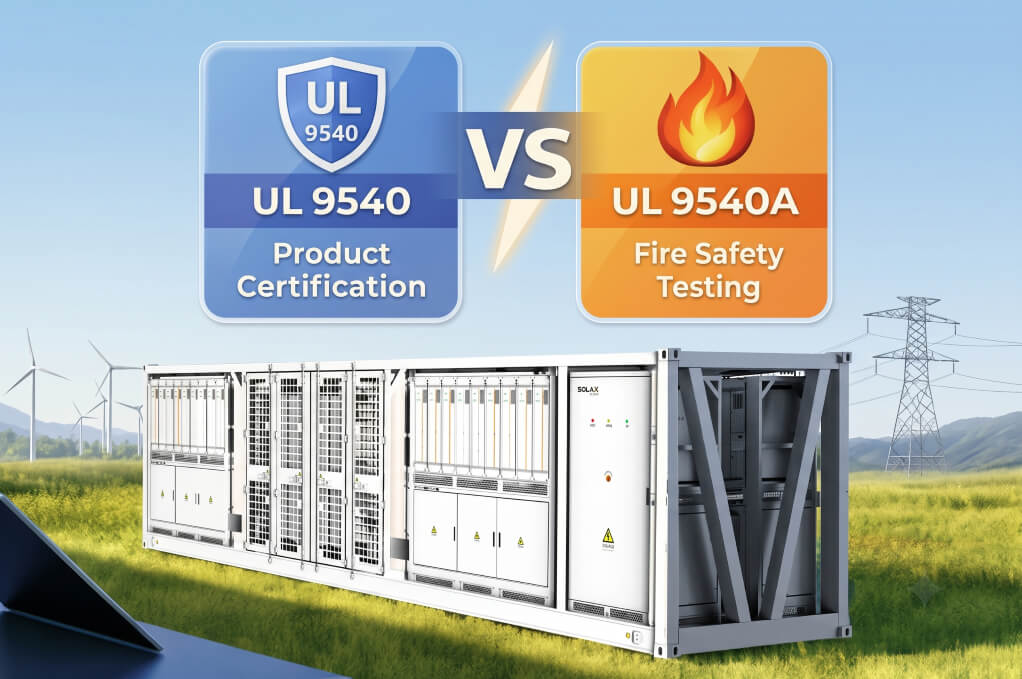
What Is UL 9540?
UL 9540 is a system-level safety standard for Energy Storage Systems(ESS). It evaluates the complete, integrated system rather than individual components.
In other words, a UL 9540 battery system must demonstrate that batteries, power electronics, controls, thermal systems, and protective mechanisms operate safely as one integrated unit.
Recognized by ANSI and SCC, the UL 9540 standard is referenced by major codes including the International Fire Code (IFC) and NFPA 855. In many U.S. jurisdictions, compliance is mandatory.
What does UL 9540 certification include?
Key UL 9540 requirements typically include:
Battery modules (commonly certified to UL 1973)
Power Conversion System (PCS) / inverters (UL 1741)
Battery Management System (BMS) functional safety
Electrical protection and grounding
Mechanical enclosure integrity
Thermal management system performance
Fire protection system integration
Installation instructions reflecting tested safety limits
Certification is granted by a Nationally Recognized Testing Laboratory (NRTL). Once approved, the product receives a UL 9540 listing, which authorizes market deployment as a complete system.
What Is UL 9540A?
UL 9540A is a test method, not a certification standard. It is used to evaluate thermal runaway propagation and fire behavior in battery energy storage systems. It generates technical data used by engineers, code officials, and fire authorities to assess system-level fire risk.
UL 9540A Test Method: Four-Level Evaluation Structure
UL 9540A testing follows a stepwise approach, scaling from individual cells to full installation scenarios.
1. Cell Level
Induced thermal runaway of a single battery cell
Measurement and analysis of released gases
Evaluation of combustion characteristics
2. Module Level
Assessment of cell-to-cell propagation
Iterative triggering (1 cell → 2 cells → 3 cells, if required)
Collection of gas and heat release data
3. Unit Level
Testing of a complete battery cabinet or enclosure
Observation of flame ejection outside the enclosure
Measurement of temperature rise within and around the unit
4. Installation Level
Multi-unit layout simulation
Evaluation of spacing between units
Assessment of fire suppression effectiveness
Analysis of deflagration and gas accumulation risks
Testing proceeds sequentially depending on observed hazards and code requirements.
UL 9540 vs UL 9540A: Core Differences
UL 9540 and UL 9540A are related, but they serve different technical and regulatory purposes.
UL 9540 is a system-level safety certification standard. It determines whether a complete energy storage system can be certified and listed.
UL 9540A is a fire propagation test method. It generates fire test data used to evaluate thermal runaway and installation safety.
Category | UL 9540 | UL 9540A |
Type | Certification standard | Test method |
Purpose | Certifies complete ESS safety | Evaluates fire and thermal runaway behavior |
Output | Listing / Certification | Test report |
Scope | Electrical, mechanical, system integration safety | Thermal runaway propagation and fire risk |
Required for installation | Yes (in most U.S. jurisdictions) | Required when installation exceeds code baseline limits |
Common misconception | "Battery certification" | "UL 9540A certification" (incorrect term) |
From Code Compliance to Extreme Scenario Validation
Understanding the difference between UL 9540 and UL 9540A clarifies regulatory requirements. However, as energy storage systems scale to multi‑megawatt capacities, another question emerges:
Are standard compliance tests enough to define real-world safety boundaries?
Traditional UL 9540A testing evaluates thermal runaway propagation and fire behavior. But large-format containerized systems introduce additional variables:
High energy density
Enclosed gas accumulation
Pressure wave development
Structural stress during deflagration
In large-scale installations, the concern is no longer only fire spread — it is whether the system can withstand a worst-case deflagration event without structural failure or secondary hazards.
This is where system-level extreme testing becomes critical.
Case Study: SolaX ORI 5MWh System-Level Deflagration Test
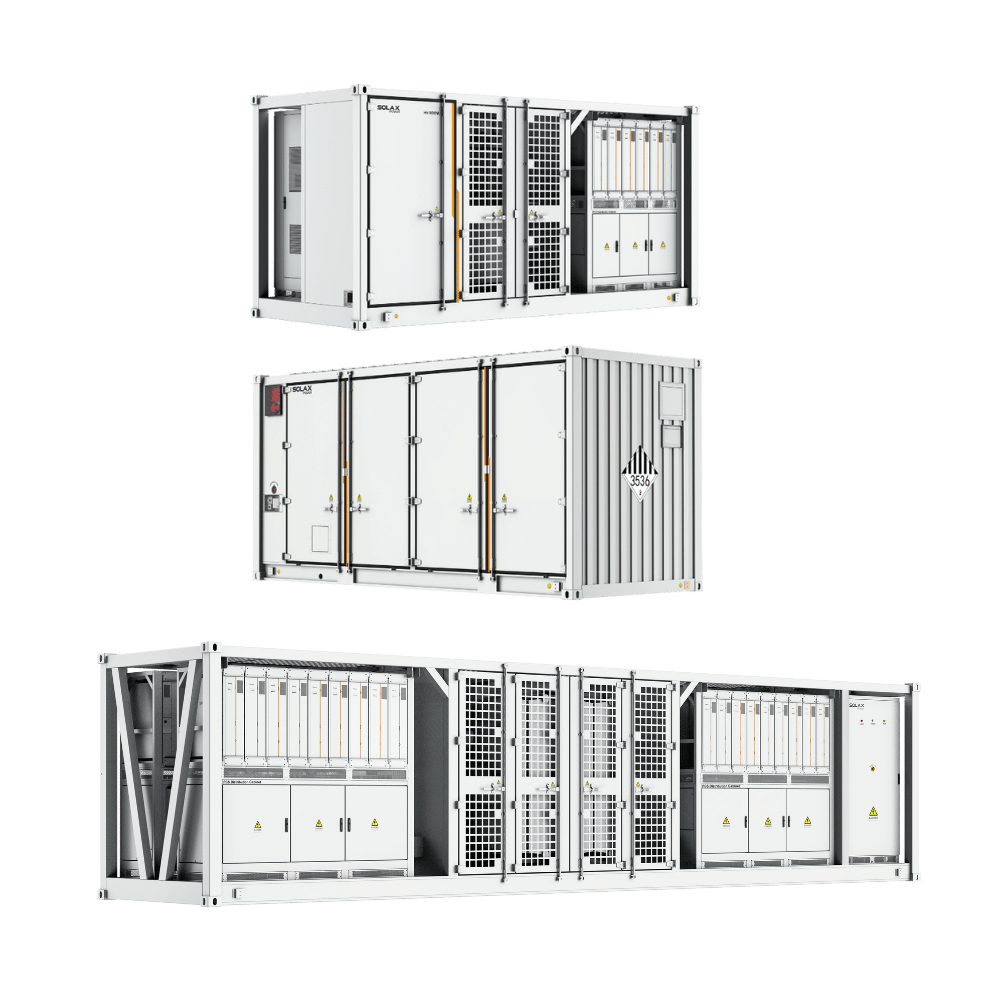
To evaluate safety boundaries beyond baseline compliance, the SolaX ORI 5MWh large-scale energy storage system underwent a full-scale system-level deflagration test under the proposed UL 9540A:2025 framework, conducted with UL Solutions.
Unlike conventional unit-level fire tests, this scenario intentionally recreated a severe gas accumulation condition:
Real lithium-ion cells were driven into thermal runaway
Emergency ventilation systems remained closed
Flammable gases were allowed to accumulate
A deflagration event was triggered under controlled conditions
This test was designed to challenge structural integrity, pressure-relief pathways, and system-level safety logic under extreme conditions.
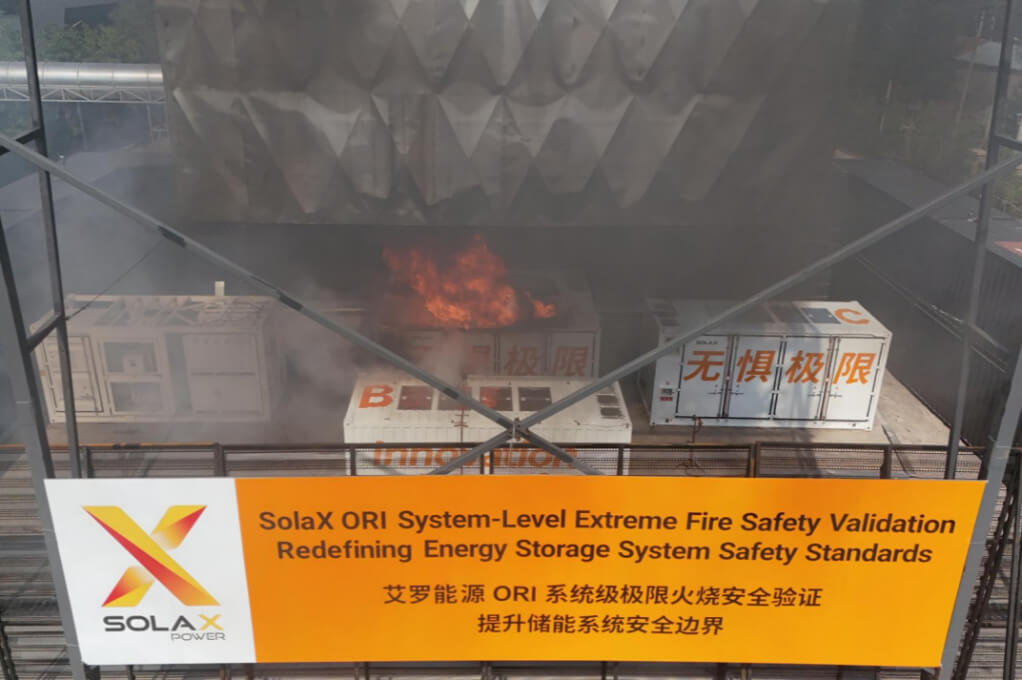
Key Observations
During the deflagration event:
The pressure-relief structure activated as designed
Container doors remained closed
No structural rupture occurred
No fragments were ejected
Adjacent containers showed no thermal runaway propagation
Maximum recorded temperatures in neighboring units remained well below critical thresholds
The results demonstrated that even under high-severity internal gas ignition, the system maintained structural containment and controlled risk exposure.
Why This Matters Beyond Certification
UL 9540 certification confirms system compliance.
UL 9540A testing provides fire propagation data. But full-scale deflagration validation provides something more:
Engineering proof of structural resilience
Quantified system-level safety margins
Greater confidence for AHJs and insurers
Improved bankability for large-scale projects
As energy storage systems move into urban and high-density installations, defining safety under worst-case scenarios becomes as important as meeting certification standards.
Conclusion
As energy storage systems scale in capacity and deployment density, compliance alone is no longer sufficient. True industry leaders move beyond minimum requirements. They proactively validate structural resilience, gas management strategies, and system-level safety logic under extreme conditions.
Safety is no longer about passing a test. It is about proving system integrity under the worst-case scenario.
Table of Contents
Latest News
Explore expert insights, practical guides, and the latest news on SolaX Power.


To the Latest Newsletter
Stay Ahead with the Latest SolaX Updates!
Subscribe
I have read and agree to Privacy Policy and User Terms